Since 21st January 2026, self-employed people have been able to apply for an Enhanced DBS check themselves for the first time. It’s a significant change for sole traders working with children or vulnerable adults, and it has just become more pressing.
On 17th September 2026, the Disclosure and Barring Service (DBS) launched Every Check Helps, a national campaign telling parents and carers they can ask self-employed tutors, coaches, nannies, carers and therapists to see their DBS certificate.
In this guide, we explain what a DBS check is, what has changed, who it affects, what clients will now be asking for, and how to get one.
What is a DBS check?
A DBS check is a certificate that discloses elements of a person’s criminal history and, at the higher levels, relevant police information. It can also confirm whether someone is barred from working with children or vulnerable adults.
There are four levels:
- Basic: shows unspent convictions and conditional cautions only. Anyone can apply for one themselves.
- Standard: shows spent and unspent convictions, cautions, reprimands and warnings, subject to filtering rules.
- Enhanced: includes everything in a Standard check, plus any relevant information held by local police.
- Enhanced with Barred List: an Enhanced check that also confirms whether the person is on the Children’s and/or Adults’ Barred List.
For most self-employed people working with children or vulnerable adults, the Enhanced check is the one that matters.
What changed in January 2026?
Enhanced DBS checks can only be obtained through a DBS Registered Body or DBS Umbrella Body.
Until January 2026, only organisations could use this route. The thinking was that an organisation needed to make the eligibility and suitability decision based on the outcome.
That left self-employed tutors, carers, coaches and contractors unable to get the check their work called for. Personal employees had the same problem. A family employing a nanny directly, for example, had no way to request an Enhanced check for them.
That has now changed. Eligible self-employed people and personal employees can apply for an Enhanced check, including Barred List checks where the role qualifies, through a registered Umbrella Body.
Who does it affect?
The change applies to paid, self-employed workers and personal employees whose work is eligible for an Enhanced check. That includes:
- Private tutors and music teachers
- Sports coaches and activity instructors
- Nannies and other personal employees
- Self-employed carers and personal assistants
- Counsellors and therapists working with children or vulnerable adults
Eligibility depends on what the role actually involves, not the job title. Volunteers aren’t covered by this route. If you’re unsure where you stand, a free DBS eligibility checker will tell you in a couple of minutes.
Parents are now being told to ask
The Every Check Helps campaign aims to close an awareness gap. Many parents and carers still don’t know that self-employed workers can now get an Enhanced check, and some feel uncomfortable asking.
The campaign’s message to them is simple: the person you’re hiring can get a DBS check, and you can ask to see it.
For self-employed workers, that changes the conversation with every new client. Families are being actively encouraged to ask for proof before they hire. Those without a certificate risk losing work to someone who has one.
It’s worth knowing that parents cannot apply for a check on your behalf. Only you can apply, through a registered Umbrella Body.
What parents and carers will look for
The DBS guidance for parents and carers tells families to check:
- The original certificate: not a photo or photocopy
- The level: an Enhanced check for work with children or vulnerable adults
- The Barred List: whether it includes the Children’s and/or Adults’ Barred List, where the work requires it
- The workforce: that it covers the right group, whether children, adults or both
- The issue date: a certificate only reflects information up to the day it was issued
- The DBS Update Service: if you’re subscribed, they can check your status online, with your permission
DBS is also clear that a certificate should be one part of a family’s decision, alongside references, qualifications and experience.
How to apply
- Check your eligibility. Your role must be paid and involve work that qualifies for an Enhanced check. A free eligibility checker will confirm this in a couple of minutes.
- Choose a registered DBS Umbrella Body that accepts self-employed applicants. You can’t apply to the DBS directly.
- Complete the application online. You’ll need your personal details, five years of address history and details of your role.
- Verify your identity, either digitally with a biometric passport or EU ID card, or with standard documents.
- Receive your certificate by post. Keep the original safe, as that’s what clients will ask to see.
Applications can be completed online in minutes, but results can take anywhere from a few days to several weeks, depending on police checks.
How much does it cost?
DBS fees are falling from 5th October 2026:
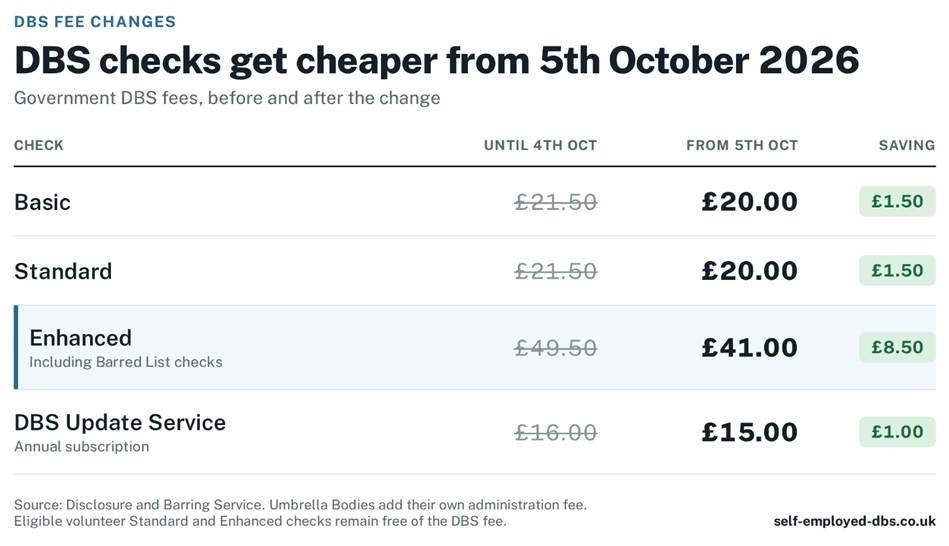
Umbrella Bodies add their own administration fee on top of the DBS fee, so compare total prices before you apply.
Should you join the DBS Update Service?
If you work with multiple clients, yes. The Update Service keeps your certificate current, and it lets clients check your status online for free, with your permission.
You must register within 30 days of your certificate being issued.
How to get ready
- Apply now if you haven’t already, before clients start asking.
- Join the Update Service as soon as your certificate arrives.
- Keep your original certificate to hand for first meetings with new clients.
- Pull together your supporting documents: qualifications, references and insurance.
For guides on the campaign and the questions clients are likely to ask, see the free Every Check Helps support and guides hub.
Scotland and Northern Ireland
The Every Check Helps campaign covers England, Wales, the Channel Islands and the Isle of Man.
In Scotland, checks are handled by Disclosure Scotland, and in Northern Ireland by AccessNI.