

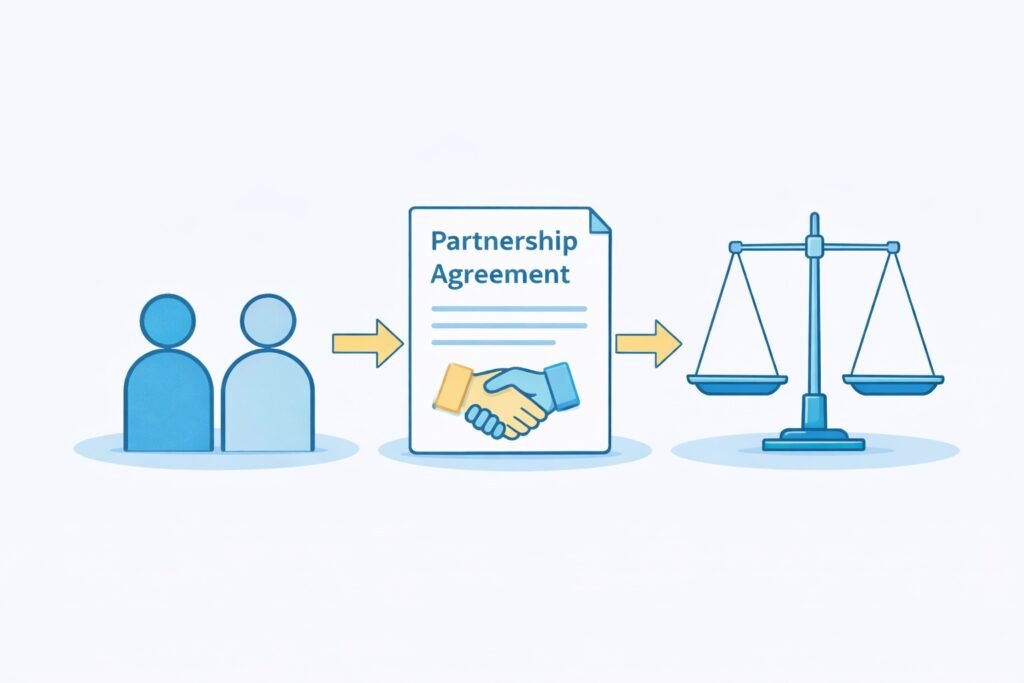
Many businesses are built on partnerships. When things are working well, informal arrangements and a shared understanding may feel sufficient.
However, problems tend to arise later, not at the start, when partners disagree on direction, budgets, workload, or how to grow the business.
Without a partnership agreement, it can be unclear who has decision-making authority, how disputes should be resolved, or what happens if one partner wants to leave.
In practice, situations like this can escalate quickly and damage an otherwise viable business.
This is why partnership agreements are so important.
Read our guide to setting up a partnership.
Getting out of a partnership
If you do not have a partnership agreement and are unhappy in a business relationship, it’s usually quite easy to leave.
You may be able to exit the business by giving ‘notice’ to the other people with whom you formed the company and have been working.
In England and Wales, where there is no written agreement, partnerships are commonly treated as a ‘partnership at will’ under the Partnership Act 1890, which can be dissolved by notice (see section 26).
A partnership agreement makes this more difficult by setting out rules for introducing new partners and for those who choose to leave.
It will usually govern the financial implications of an individual leaving or the closure of the entire business, along with any related freehold or leasehold property issues.
One other practical point that catches people out is liability. Under the Act, partners can be liable for the firm’s debts and obligations, even if the problem was caused by someone else in the partnership.
Further protection
You can formalise your business arrangements in different ways, such as by forming a limited company, which creates an entity in its own right rather than just a partnership of individuals.
Companies House also explains this separation in plain English in its blog.
Without a limited company or partnership agreement in place, the individual members of a business are usually considered to be in a ‘partnership at will’, a situation that can be ended quickly, with little notice given to the remaining partners.

80% off Xero Accounting Software for 6 months
Fully compatible with Making Tax Digital (MTD) for sole traders from April 2026.
If you choose to leave, having one or more of these formal arrangements in place can help you avoid losing out on your share of the business.
You may be able to claim a portion of any capital or profits that have accrued while you have been involved.
Creating a Partnership Agreement
A partnership agreement is an important document that can significantly impact your financial situation and the future of a business you choose to leave or remain in as a partner.
This makes it important to ensure the clauses and wording are precise (see below), so you might want to involve a lawyer to draft the initial document and address potential issues.
You can download a template agreement from several online legal document providers if you don’t want to involve a lawyer. Some websites will even allow you to create your own partnership agreement by answering a series of questions.
Remember, too, that the partnership agreement is there to protect everyone involved and the business as an entity in its own right. So, if one of your colleagues is reluctant to enter into a formal agreement of this kind, you should ask some very serious questions about why that is.
It is also worth spelling out how disputes will be handled before they escalate. In England and Wales, the courts expect parties to follow the pre-action rules and consider settlement before litigation; non-compliance can affect costs.
Partnership agreement – typical clauses
A well-drafted partnership agreement should address the key commercial, financial, and operational issues that can otherwise lead to disputes. Common clauses include:
- Capital contributions – how much each partner contributes initially and whether further funding may be required.
- Profit and loss sharing – how profits and losses are allocated between partners.
- Decision-making and voting – who can make decisions and which matters require agreement from all partners.
- Roles and responsibilities – what each partner is expected to do within the business.
- Admitting new partners – the process for bringing in additional partners.
- Exit and retirement – how a partner leaves, including notice periods and how their share is valued.
- Dispute resolution – how disagreements are handled, including mediation and arbitration.
- Restrictions on partners – confidentiality, non-compete terms, and limits on outside activities.
- Dissolution – when and how the partnership can be wound up.
- Distribution of assets – how assets and liabilities are dealt with on dissolution.
- Insurance and indemnities – protection against claims arising from partnership activities.
- Intellectual property – ownership of IP created during the partnership.
- Banking and financial arrangements – who controls bank accounts and financial authority.
Find out how to create a partnership agreement at the British Business Bank, and access a free template here.