


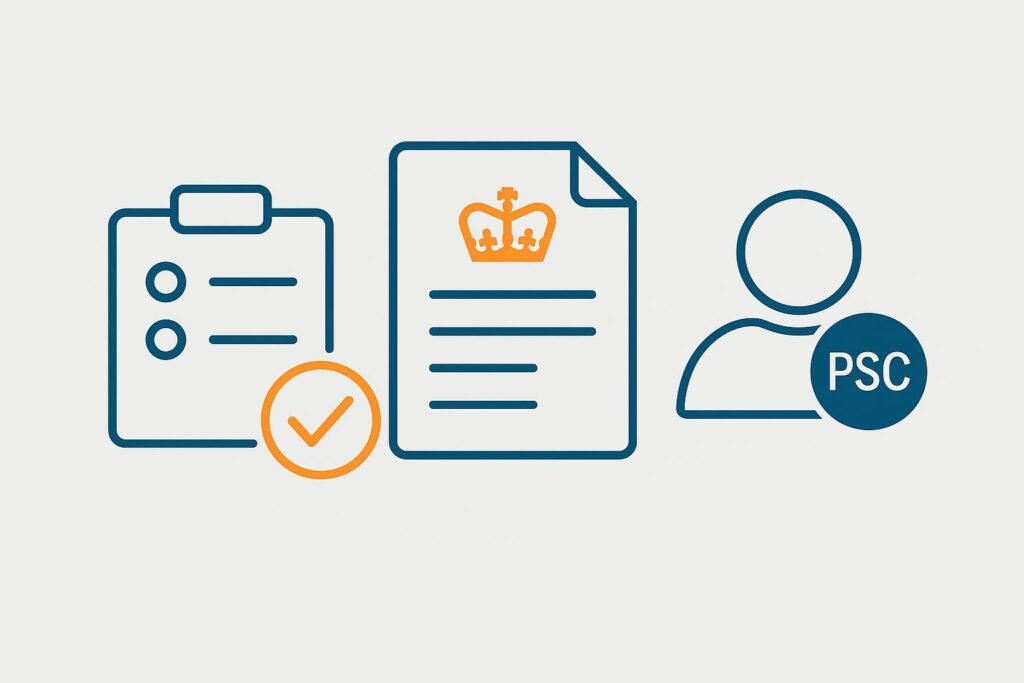
All limited companies and LLPs – both large and small – must file a confirmation statement at least once per year at Companies House.
The statement confirms that the information about your business held on record at Companies House is accurate and up to date.
It helps keep Companies House records accurate and supports anti-fraud efforts under the UK’s corporate transparency rules, including who owns or controls the company.
What information is included in a confirmation statement?
The statement contains a snapshot of your company’s information, including:
- Company name and registered office address
- Details of company officers – directors and secretary
- Details of people with significant control (PSC)
- Share capital and shareholdings
- Standard Industrial Classification code(s) (SIC)
- Statement of capital for companies with share capital
- Trading status of shares for public companies
Registered email address – a new requirement from 5th March 2024
All companies must now provide an email address to Companies House when filing. Companies House will use this email to contact you about your limited company. Importantly, your email address will not be published on the public register.
Statement to confirm the company is lawful – from March 2024
All companies must also confirm that the company’s intended future activities will be lawful.
You need to confirm this every year. Without this, you cannot file your confirmation statement. If you’re filing electronically, all you need to do is click a check box.
Find out about the new Companies House rules here.
Who has to file a confirmation statement?
All limited companies and LLPs registered in the UK must file a confirmation statement regardless of the size or trading status of the company.
- Private limited companies (Ltd)
- Public limited companies (PLC)
- Limited liability partnerships (LLPs)
- Community interest companies (CICs)
Even dormant companies fall within this category. You must file a confirmation statement annually, even if nothing has changed. Sole traders and general partnerships are not required to file a confirmation statement because they are not registered with Companies House.
How to file a confirmation statement
Gather information
Get your company details and ensure they are correct and up to date.
Decide how you will file your statement
- Online: Log into your account on the Companies House website. This is the simplest method.
- If you have an accountant, they can file on your behalf as your authorised agent.
- By post: You can download and complete form CS01 for companies or LLCS01 for LLPs from the Companies House website.
Check the information already on the register
You need to check all the pre-populated information provided by Companies House.
Make any changes if you need to
If any of the information is incorrect or out of date, you need to update it. Some changes will require separate forms or notifications.
Confirm the statement is correct
Once you know all the information is correct, you confirm the statement as a company’s officer (or representative, such as an accountant).
Pay the filing fee
Follow the online payment process. See more about the fees below.

80% off Xero Accounting Software for 6 months
Fully compatible with Making Tax Digital (MTD) for sole traders from April 2026.
File the statement
If you are using the online system, filing happens automatically upon payment. If posting, send the completed form to Companies House.
Note that you are supposed to file your confirmation statement 14 days after the end of your review period. The review period ends on the anniversary of your incorporation date or the date when you last filed your confirmation statement.
The PSC Register: People with Significant Control
Since 6 April 2016, all UK companies (except listed ones) have been required to identify and report their People with Significant Control (PSC).
The requirement was introduced as part of the Small Business, Enterprise and Employment Act 2015 to improve corporate transparency, particularly where complex structures may hide true ownership.
Which companies must maintain a PSC register?
All UK limited companies, LLPs, CICs, unlimited companies and PLCs must keep a PSC register, even if they are dormant.
Sole traders, ordinary partnerships, limited partnerships (LPs), and Charitable Incorporated Organisations (CIOs) are exempt from maintaining a PSC register.
Who counts as a PSC?
A PSC is an individual or legal entity that meets one or more of the following conditions:
- Holds more than 25% of the company’s shares
- Holds more than 25% of the company’s voting rights
- Has the right to appoint or remove the majority of the board of directors
- Exercises, or has the right to exercise, significant influence or control over the company
- Exercises control over a trust or firm that meets any of the above conditions
Tip: Don’t assume someone needs more than 50% to be a PSC – the threshold is just over 25%.
Creating and maintaining the PSC register
You must take reasonable steps to identify anyone who meets the PSC criteria. Once identified, you must:
- Confirm their details (you can send a 790D notice if needed)
- Record the details in your internal PSC register
- Report the information to Companies House (via the confirmation statement or using PSC01–PSC09 forms)
If you cannot identify a PSC, you must state that in the register. If you believe someone is a PSC but they haven’t confirmed it, you can serve a 790D notice to request confirmation. You should also note that the notice has been sent, even while awaiting a reply.
What if there are no PSCs?
If your company doesn’t have any PSCs (for example, five shareholders each with 20%), the register must still state this. It cannot be left blank. Add a statement such as: “The company knows or has reasonable cause to believe that there is no registrable person or registrable legal entity in relation to the company.”
PSC register for companies without shares
Companies limited by guarantee and LLPs still need to assess PSC criteria, but shareholding conditions don’t apply. You’ll need to consider other forms of control instead.
Information to include in the PSC register
- Name
- Date of birth
- Nationality
- Country of residence
- Service address and usual residential address (the latter is not publicly available)
- Date they became a PSC
- The nature of control (e.g. owning 25%-50% of shares)
Tip: You must state which shareholding or voting rights band the PSC falls into: 25%-50%, 50%-75%, or over 75%.
Updating PSC details
As soon as you become aware of changes to PSC status — such as new share transfers or allotments — you must update your internal register and notify Companies House. Don’t wait until the next confirmation statement.
Public access to PSC information
Companies House publishes PSC details on the public register. Anyone can view a company’s PSC information online. However, residential addresses are not shown.
Upcoming changes for 2025/26
Mandatory ID verification (from autumn 2025)
All company directors, PSCs and those filing documents with Companies House must verify their identity. This will be done through GOV.UK One Login. If you’re newly appointed, you must verify within 14 days. Existing PSCs will have a transition period — likely tied to your next confirmation statement. For full details, visit Changes to UK company law.
Centralised statutory registers (from April 2025)
Companies will no longer be required to keep physical registers (including the PSC register) at their registered office. These records will be maintained digitally at Companies House, though companies must still ensure their records are accurate and up to date.
Full shareholder names may be required (TBC)
Companies House plans to require full names of all individual shareholders in future confirmation statements. This change is not yet live but is expected soon. Keep an eye on official announcements.
Confirmation Statement Filing Costs
Companies House increased many of its filing fees in May 2024. You can view the full schedule here. Here’s what you need to pay:
- Online filing: £50
- Paper filing: £110
This fee covers all confirmation statements filed within a 12-month period – so you won’t pay more if you file more than once in a year.