

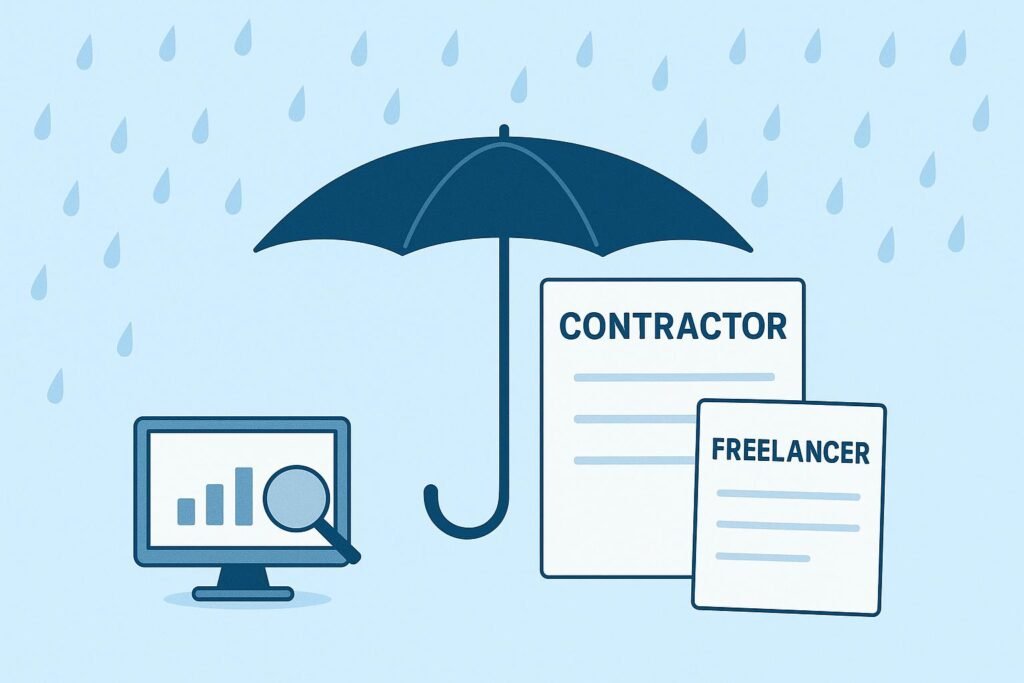
On ByteStart, we often cover the main routes into self-employment, from operating as a sole trader to forming a limited company.
Many contractors set out with the aim of running their own business, usually through a limited company.
In practice, the choice is not always theirs.
Since the introduction of the off-payroll (IR35) rules, and with some clients banning limited company engagements altogether, an increasing number of contractors have been required to use umbrella companies for at least some of their contracts.
An umbrella company employs you directly, so you are treated as a PAYE worker.
The umbrella invoices the client or agency, collects the money, deducts Income Tax, National Insurance and its margin, then pays you your net salary.
While IT contractors were early adopters, umbrellas are now common in education, healthcare, social work, event staffing and logistics.
For contractors who would prefer to run their own company, umbrellas can feel like a compromise, but they remain the most straightforward option when your client or agency insists on them.
Choosing an umbrella company: positives
- This is often described as a hassle-free way to contract. You avoid the administrative and statutory responsibilities that come with running a limited company.
- For short-term roles or new contractors, an umbrella can be a practical solution compared to setting up a company straight away.
- Unlike company directors, you do not need to file a Self Assessment tax return unless you have received untaxed income during the tax year.
- You do not need to open a separate business bank account to receive your earnings.
- Set up is simple. You join the umbrella and provide your contract and personal details. You send your timesheet to the umbrella. The umbrella company invoices the client or agency and pays you after deducting the necessary fees.
- Statutory employment rights. As an employee of the umbrella, you are entitled to holiday pay, sick pay and pension auto enrolment. Read more about holiday pay rules.
- Continuity of employment. You keep the same employer on paper even if you move between contracts. This can help with mortgage and tenancy checks.
Choosing an umbrella company: negatives
- Assuming your contract work is not caught by the IR35 (off payroll) rules, a limited company is usually more tax efficient because dividends are not subject to employers’ NIC.
- Limited company owners have greater tax planning options. You cannot split income with a spouse, defer dividends or use similar strategies inside an umbrella.
- Employers’ costs reduce the assignment rate. Employers’ NIC and the Apprenticeship Levy are taken from the assignment rate agreed with the agency or client. Make sure your payslip clearly displays these items.
- If you want to run your own business and control day-to-day operations, an umbrella is not the best fit.
- Although many umbrellas are well run, some are not transparent about take-home pay. In reality, the only difference between umbrellas should be the margin they charge. All PAYE providers must deduct the same taxes by law.
- Watch for poor practice around holiday pay and opaque payslips. Verify how holiday pay is calculated and displayed.
Questions to ask prospective umbrella firms
- Fees: What are the weekly or monthly gross and net fees? Ask for the charge before tax relief and the effective cost after relief.
- Payment terms: Do they pay on fixed dates or immediately upon receipt of funds from the client or agency?
- Speed: Do they use Faster Payments?
- Age and reputation: How long have they traded? Do they hold accreditations such as FCSA membership? Are payslips independently checked, for example, by SafeRec?
- Service levels: What service guarantees do they offer?
- Personal service: Will you have a named account manager?
- Business insurance: Do they include professional indemnity or public liability cover?
- Expenses: Are they realistic about the SDC rules and the minimal scope to claim expenses?
- Other benefits: Do they offer extras such as healthcare or legal cover?
- Technology: Is the online portal reliable and easy to use?
- Holiday pay: Is it accrued and paid transparently or rolled up into the rate? Ask to see an example payslip.
- Employers’ NICs: Are employers’ NICs and the Apprenticeship Levy shown clearly as deductions from the assignment rate?
A word of warning about unscrupulous schemes
There are many legitimate UK PAYE umbrella companies. There are also schemes to avoid.
- Unrealistic take home promises. If someone promises 80 per cent net pay, that is not possible under PAYE. These arrangements often disguise loans or offshore payments. HMRC can pursue you later for unpaid tax. See HMRC’s note on tax avoidance loan schemes and the Loan Charge.
- Mini umbrella companies. Promoters create many small companies to exploit reliefs. HMRC has warned about this practice. Read the guidance on mini umbrella company fraud.
- Non-UK umbrellas. Overseas arrangements can leave you exposed if taxes are not paid correctly.
If in doubt, check the FCSA member list and only use a straightforward UK PAYE provider.
What if you have no choice
Since the implementation of the off payroll (IR35) reforms in 2021, many contractors who wanted to run their own limited company have found that some clients will not allow it.
In sectors such as education and healthcare, umbrellas are often the default for agency workers. Some agencies also use preferred supplier lists and may steer you toward a specific umbrella, which limits your freedom to choose.
Whatever your situation, compare several providers, insist on clear net pay calculations and make sure you understand every line on the payslip.
Even if you do not want to use an umbrella, you may have to for some contracts, so treat the choice of provider as seriously as you would any other business decision.
The outlook for umbrella working
The umbrella market is not yet formally regulated. The government has confirmed that a consultation on umbrella company regulation will take place in Autumn 2025, with legislation expected to follow in 2027.

90% off Xero Accounting Software for 6 months for ByteStart readers!
Fully compatible with Making Tax Digital (MTD) for sole traders from April 2026.
Umbrella companies suit many contractors in short term roles or where contracting through a limited company is not an option.
They provide simplicity and employee rights, at the cost of tax efficiency and control. If you value flexibility and tax planning, a limited company may still be the better option.
If you want a straightforward way to be paid, or your client or agency requires it, an umbrella can be the right choice.
There are some good umbrella company listings here and here.