

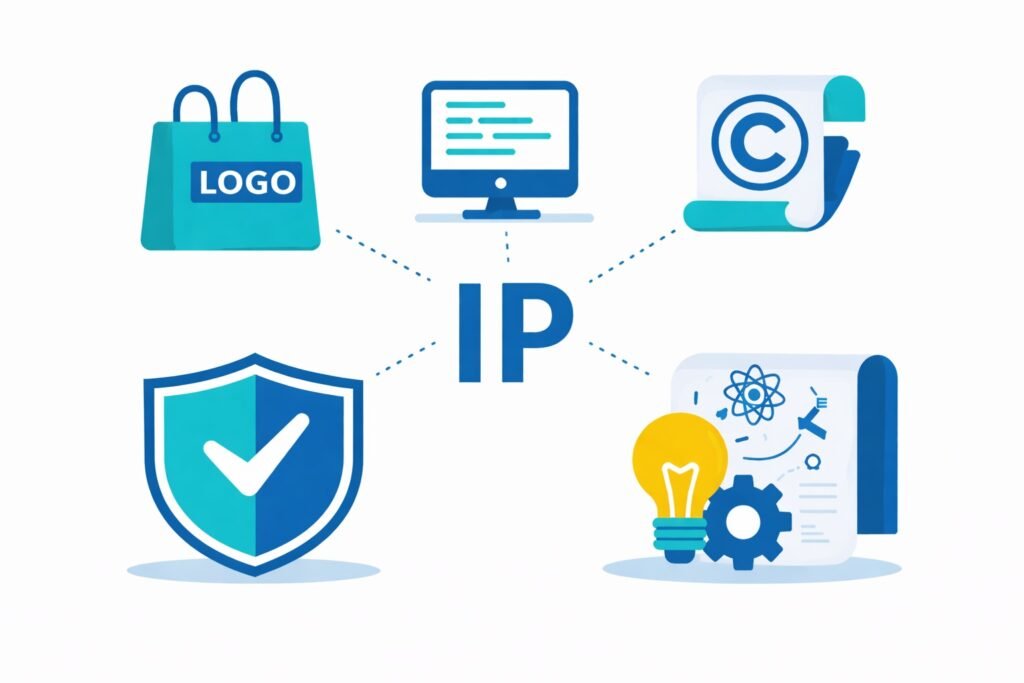
As a small business owner, you’ve probably heard of the phrase “intellectual property”, or IP, as it’s commonly referred to. But studies show that, despite knowing what intellectual property is, many small businesses still assume that protecting IP is only for larger, well-known businesses.
The fact is that IP protection is something that many start-ups and small businesses can benefit from considering early on, because without the right protection, businesses can lose some of their most valuable assets or find themselves in avoidable disputes.
To help you get to grips with the subject, this guide covers key intellectual property rights small business owners need to know. It also includes a small number of practical updates from ByteStart for 2026, based on the IP issues that most often affect sole traders and small limited companies.
What small businesses often get wrong about IP
Before examining the different intellectual property rights, it helps to clarify a few common assumptions that regularly cause problems in practice.
- Paying for work does not automatically mean you own the IP. If a freelancer designs your logo, writes website copy, produces photographs, or builds software, ownership can depend on your contract and the terms actually agreed upon.
- An idea on its own is not IP. Intellectual property usually protects something that has been created and recorded in some form, not a business idea that has never been written down or produced.
- Owning a domain name does not give you trademark rights. A domain does not automatically stop another business from using a similar name in the same market.
- Leaving protection too late can be expensive. Problems often surface after branding, packaging, websites, or marketing materials have already been built.
None of this means you need to spend a fortune on legal advice on day one, but it does mean it is worth understanding what your core IP assets are and where basic checks can reduce risk.
What is intellectual property law?
Intellectual property law exists to protect creative work from being copied or exploited without the permission of the creator or legal owner of that creative work.
Intellectual property is something unique that has actually been physically created. An idea alone does not constitute intellectual property, although recording that idea in writing or through a design may.
Some types of intellectual property automatically exist as legal rights without the owner having to register them. Other types of intellectual property rights require action, such as registration with a government organisation, before the IP right can legally exist.
Once someone has a legal intellectual property right in a work, they can take action to prevent others or businesses from using or exploiting it.
There are different types of intellectual property rights which apply to different types of intellectual property. The key types of relevance to small businesses are trademarks, patents, copyright, and registered design rights.
Trademarks
Registered trademarks
If you have a brand that is unique to your business, you may be able to register it as a trademark. The law allows certain brands to be registered as belonging to individuals or businesses.
You can register something as a trademark if it is a sign which is capable of being represented graphically and is capable of distinguishing the goods or services of one business from those of another business.
Signs which may be registered as trademarks include names, logos, domain names, designs, and the shape of physical goods.
Several strict criteria must be met before a mark can be registered as a trademark. For example, your trademark must be unique. Vague or generic descriptions, such as “we are the best”, cannot be registered as trademarks.
Descriptions of what a product is, such as “Froot Loops” to describe a fruit cereal, are also not capable of being registered as a trademark.

90% off Xero Accounting Software for 6 months
Fully compatible with Making Tax Digital (MTD) for sole traders from April 2026.
It is important to note that registered trademarks relate to specific types of goods or services. It is possible for two separate businesses to register the same name as a trademark for different products or services, for example, “Jonesdown Estate Agents” and “Jonesdown Hairdressers”.
If your business uses any signs capable of being registered as trademarks, you may benefit from registering them. Applications are made to the government-run Intellectual Property Office.
Owners of a registered trademark can take legal action against anyone who uses their brand without permission. If a trademark becomes well-known, it may also be sold or licensed to other businesses.
Should you not register a trademark, competitors could benefit from using a similar name or damage your reputation by associating your products with theirs.
If two businesses use similar trademarks in the same market and neither intends to pursue legal action, they may be able to enter into a coexistence agreement. This is a legally binding contract that sets out how the trademarks may coexist.
Unregistered trademarks
If your business has a brand or distinguishing sign which has not been registered as a trademark, you may still be able to take legal action against another business for using it without consent. This is known as a claim for passing off.
It is worth noting that passing-off cases can be lengthy, expensive, and difficult to win compared with enforcing a registered trademark.
Patents
A patent is an intellectual property right which enables the inventor of a product or process to protect their invention. With a patent, you can prevent others from making, using, or selling copies of your invention without permission.
A patent grants the inventor a 20-year monopoly on their invention in exchange for disclosing it.
Patents usually cover products or processes which contain new technical or functional aspects. It is also possible to obtain a patent for an improvement in the way something is made or produced.
To obtain a patent, an invention must meet strict criteria. It must be new, meaning it has not been made available to the public before. It must involve a creative step and must be capable of industrial application.
Once granted, a patent gives the inventor the legal right to take action against anyone using the patented technology without permission. It is the inventor’s responsibility to enforce those rights.
As with other IP rights, patents can be licensed or sold to third parties.
It is vitally important to remember that an invention which has been disclosed to the public will not be regarded as new and cannot be granted a patent. Accidental disclosure can happen more easily than people expect, so early legal advice is often sensible where patent protection may be relevant.
Copyright
Another well-known intellectual property right is copyright. Copyright protects an original piece of work from being copied.
Types of work that can be protected by copyright include books, written works, the layout of written works, oral presentations, music, drawings, paintings, photographs, illustrations, computer programs, software, and website content.
To be protected by copyright law, a piece of work must be original and a degree of labour, skill, or judgement must have gone into creating it. The work must actually exist in some form. An idea alone is not enough.
For example, an idea for a book would not qualify for copyright protection, but the book’s written content could.
There is no requirement to register copyright in the UK. Work which meets the relevant criteria is automatically protected.
If your work is protected by copyright, other parties cannot copy it, distribute it, adapt it, publish it online, or perform it in public without permission. Copyright can also be licensed or sold, allowing others to use it under agreed terms.
Registered design rights
Registered design rights allow the owners of a product to protect its appearance from being copied. To qualify, the design must be new at the time of registration and have individual character.
This type of protection covers the overall appearance of a design, including its shape, configuration, and decoration. Examples include the shape of products, appliances, and product packaging.
Applications for registered design rights are made to the Intellectual Property Office.
How IP affects small businesses
As markets become increasingly crowded, understanding intellectual property is important for businesses of all sizes.
Research has shown that failing to obtain appropriate IP advice can have serious consequences for small businesses, including financial losses, wasted time, and long-term reputational damage.
If you are concerned that the intellectual property in your business is not adequately protected, or that you may be infringing someone else’s rights, speaking to an IP solicitor can be a sensible next step.
If costs are a concern, it is often worth obtaining quotes from multiple advisers.
This guide was originally written for ByteStart by LawSpark, a UK lawyer comparison website. It was reviewed, reformatted, and updated by ByteStart in 2026 to improve readability and add practical small business context, including common ownership pitfalls, clearer explanations of concepts versus recorded work, and updates reflecting how IP issues typically arise for sole traders and small companies.