
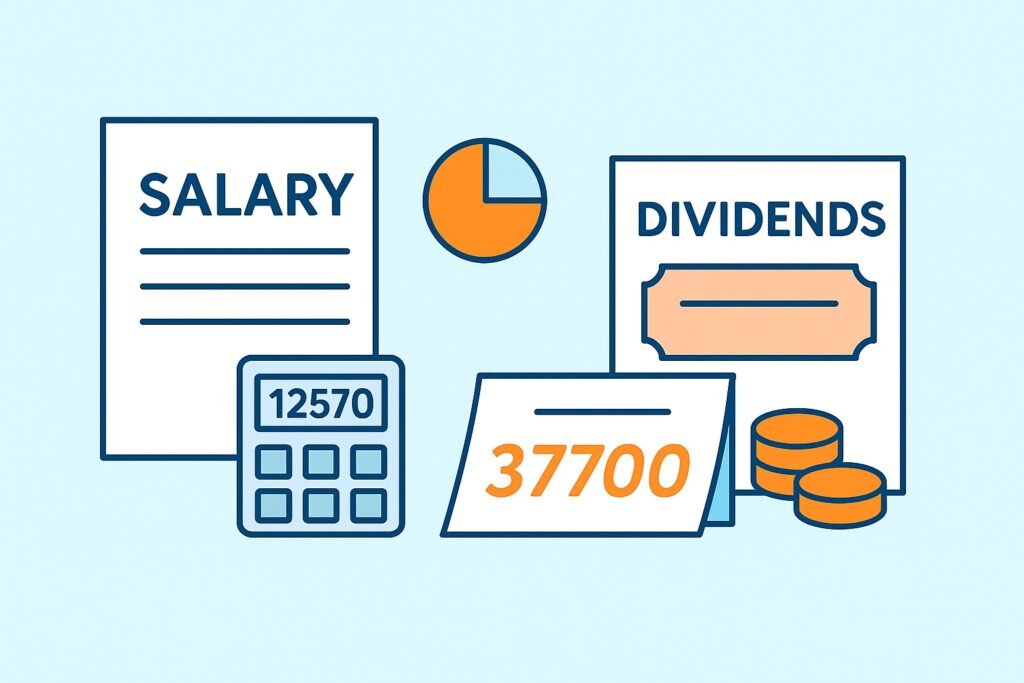
If you are a limited company director, you will typically pay yourself a salary and, as a shareholder, receive profits in the form of dividends.
So, what is the most tax-efficient salary/dividend split for directors in 2026/27?
The optimum balance will depend on your total income, whether your company can claim the Employment Allowance, and how much profit it has available to distribute.
For many directors with no other income and a full Personal Allowance, a salary of £12,570 is often a tax-efficient starting point for 2026/27. The remaining funds can then be taken as dividends, provided the company has sufficient distributable profits and the director’s overall income position allows it.
Have the tax benefits of incorporating ever been less?
Historically, operating through a limited company has been a tax-efficient way to run a business.
Corporation Tax rates have been low for some time, and dividends – until recently – were taxed favourably compared to employment income.
And you don’t pay National Insurance on dividends – but you do on a salary.
However, the tax gap between a limited company owner and a traditional employee has shrunk considerably over the past ten years.
The April 2016 dividend tax hike and the 2023 Corporation Tax rise have significantly increased the tax burden for many company directors.
Company directors have been hit again by another dividend tax rise from 6th April 2026.
Salary + Dividends
So, as a director, it is more prudent than ever to find the most tax-efficient way to remunerate yourself.
For many owner-managed companies, a common tax-efficient approach is:
- A small tax-efficient salary, which minimises exposure to income tax and National Insurance Contributions.
- The remainder of the funds as dividends, with an eye on the higher rate dividend tax band.
Your salary is also deductible against your company’s Corporation Tax bill.
How to set your salary level for 2026/27
There are several factors to bear in mind when working out the optimal salary level:
Income Tax
- Most people can use their tax-free Personal Allowance. No income tax is payable below £12,570 per year.
- Thereafter, the basic rate of income tax is 20% on income between £12,570 and £50,270.
- The 40% higher rate applies to income between £50,270 and £125,140.
- The 45% additional rate applies to income above £125,140 per year.
These are the Income Tax bands for England, Wales and Northern Ireland. Scottish rates and bands differ for salary and pension income.
Employees’ NICs
The starting rate (Primary Threshold) is aligned with the Personal Allowance at £12,570 per year.
- Between £12,570 and £50,270, you pay 8% Class 1 Employees’ NICs.
- You pay 2% on earnings above £50,270 p.a.
Employers’ NICs
Employers pay Class 1 Employers’ NICs on wages above £5,000 per year @ 15%.
Employment Allowance
If your company is eligible, the EA cancels out the first £10,500 of Employers’ NICs each year.
Eligibility depends on HMRC’s rules, including who is employed and paid above the Secondary Threshold. Find out more here.
Lower Earnings Limit
You must earn above £6,708 per year (The 2026/27 LEL) to qualify for the State Pension.
What about the April 2023 Corporation tax hike?
Please note that Corporation Tax rates increased significantly in April 2023.
This means that any CT savings mentioned in the calculations below are a minimum.
Your savings could be potentially higher if your profits are over £50,000 or more p.a.
What is the optimum director’s salary for 2026/27?
Some directors pay themselves £6,708 p.a. or thereabouts, as there is no income tax or employees’ NI, but the year will qualify towards your State Pension at or above this threshold.
However, you will still have a small amount of employers’ NI to pay.
For many directors with no other income and a full Personal Allowance, a salary of £12,570 is often one of the most tax-efficient options.
At this salary level, the only deduction you need to make is for Employers’ NICs.
a) Your company is eligible to claim the Employment Allowance
If your company meets HMRC’s eligibility conditions, the Employment Allowance can offset up to £10,500 of Employers’ NICs. Find out more here.
You don’t have to pay the first £10,500 of Employers’ NICs. So, you will have no income tax or NICs to pay.
The additional salary is deductible for Corporation Tax purposes, so paying £12,570 rather than stopping at £6,708 can still be tax-efficient where the director has their full Personal Allowance available.
b) Your company is not eligible to claim the Employment Allowance
Sole director companies are not eligible to claim the EA where the director is the only employee paid above the Secondary Threshold, but it can still be more tax-efficient to pay yourself £12,570 than £6,708.
This is because the additional salary and the Employers’ NICs the company pays are deductible for Corporation Tax purposes.
At £12,570, you pay £1,135.50 in Employers’ NICs, assuming no Employment Allowance is available.
What about dividends?
Unlike your salary, NICs are not applied to dividends. Dividend tax rates use the same bands as income tax, but with different rates for each band.
How are dividends taxed?
The first £500 of dividends are not taxed due to the Dividend Allowance.
The dividend allowance is effectively a 0% rate and still uses up part of the relevant tax band.
The tax rates payable on dividends are as follows for 2026/27;
- Personal Allowance (up to £12,570) – tax-free
- Basic Rate (£12,571 to £50,270) – 10.75%
- Higher Rate (£50,271 – £125,140) – 35.75%
- Additional Rate (over £125,140) – 39.35%
Importantly, your salary (and other additional income) will use up your Personal Allowance first, before dividends are taxed.
Dividend rates are determined by your total income, with dividends effectively sitting on top of salary and other taxable income when working out which tax band applies.
Find out more in our dividend tax guide.
What is the best salary/dividend mix?
This depends on how much income you need to draw down from your company.
In an ideal world, you want to steer clear of the higher rate dividend tax band, as dividend tax increases substantially once your total income moves into the higher-rate band.
So, if you pay yourself the most tax-optimal salary of £12,570, you have a further £37,700 of dividends available before you hit the higher rate band.
If you run your limited company with your spouse, this is one of the few remaining tax planning benefits of incorporating, as you can take advantage of your basic rate bands.
Try this popular dividend tax calculator on ITContracting.com to work out your tax liability.