
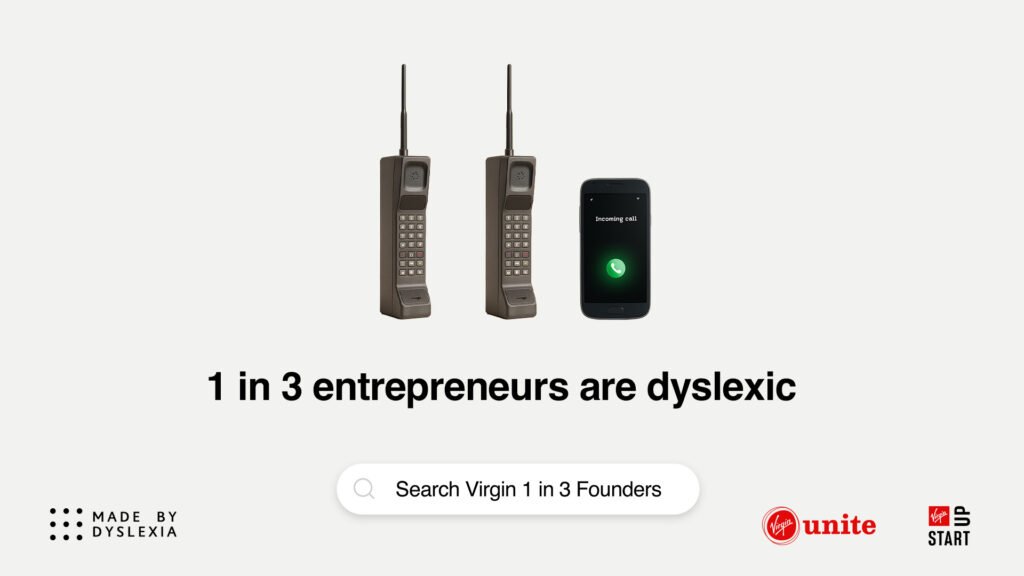
A new study suggests that roughly one in three entrepreneurs in the UK is dyslexic. The charity Made By Dyslexia says that these founders generate over £4.6 billion a year for the economy and provide more than 60,000 jobs.
The study supports a long-held business belief – many founders approach problems in a unique way, and dyslexia may play a role in that.
The research has been published alongside a new initiative, backed by Virgin StartUp and Virgin Unite.
It is called Momentum – a free business accelerator explicitly designed for dyslexic founders.
Why dyslexia shows up in business
In school, dyslexia is usually labelled as a problem. Reading and writing can be harder, exams are tougher, and confidence can take a knock. However, those same traits often emerge as strengths when someone takes the step of running a business.
People with dyslexia are more likely to be strong visual thinkers. They can spot links and patterns that others miss. They may also take a different approach to solving problems because they have had to find workarounds all their life.
It is not all positive. Admin-heavy tasks, such as filling out forms, applying for finance, or dealing with taxes, can be more challenging. The risk is that potential founders are deterred before they even begin.
Richard Branson is probably the most famous example of a dyslexic entrepreneur. He left school without strong exam results, but went on to build one of the world’s best-known business groups. He describes dyslexia as his “superpower” because it forced him to focus on big-picture thinking and surround himself with people who could do the detail.
The Momentum accelerator
Momentum is an eight-week programme that mixes one-to-one mentoring with workshops and peer sessions. The aim is not to “fix” dyslexia, but to use it as the starting point. By giving people tools to build on their strengths, the organisers hope to remove some of the barriers that prevent great ideas from turning into businesses.
Virgin StartUp says the accelerator is open to anyone in the UK who identifies as dyslexic. It does not matter if you are just starting out or already running a business – the programme is designed to be flexible.
A new online space has also been set up within the Virgin StartUp community where dyslexic entrepreneurs can connect, swap advice and share resources.
Public campaign
To raise awareness, a public awareness campaign is being conducted in 46 towns and cities. Posters highlight “Dyslexic Thinking” as a valuable skill in business. It is another step in a wider effort to change perceptions.
Back in 2022, LinkedIn added “Dyslexic Thinking” as a recognised skill after a joint campaign by Virgin and Made By Dyslexia. Several dictionaries have since followed suit. The term is now being used more openly by business leaders as a way to describe a distinct approach to problem-solving.
The hope is that more people will view dyslexia as a strength, or at least as something that does not disqualify them from starting a business.
Branson’s role
Branson has long argued that his dyslexia pushed him towards entrepreneurship. He says it taught him to focus on ideas and rely on others for detail, which became a strength rather than a weakness.
By lending his voice to the Momentum campaign, he is helping to give it visibility. He argues that businesses – and the broader economy – do better when they include different ways of thinking.
Barriers that remain
Despite the positive stories, there are still hurdles to overcome. Dyslexic founders can struggle with finance applications because the system is designed around forms and written evidence.
Tax compliance and regulation can be difficult without support. And in many schools, dyslexia is still viewed only as a difficulty, rather than as a distinct way of learning.
Made By Dyslexia says this wastes potential. If more people with dyslexia were given the tools and confidence to start up, the number already contributing billions to the economy could be even higher.
Momentum is the first accelerator to take this approach in the UK. Whether it works as a model for others will depend on how many founders it helps and how sustainable the support is. But it marks a change in tone – a shift from seeing dyslexia purely as a challenge to recognising it as part of the mix that drives entrepreneurship.
Why it matters for new founders
For anyone considering self-employment, the message is clear enough. There is no single type of entrepreneur. People succeed in different ways, and different skills are useful.
The story also links into wider questions about barriers to starting a business.
A recent government-backed review – the Maple Review – is examining how economic disadvantage prevents people from starting their own businesses. Dyslexia fits into the same picture. It is another reminder that talent is wasted when the system only works for one type of founder.
For those who want to apply, details of the Momentum programme are available on the Virgin StartUp website.