

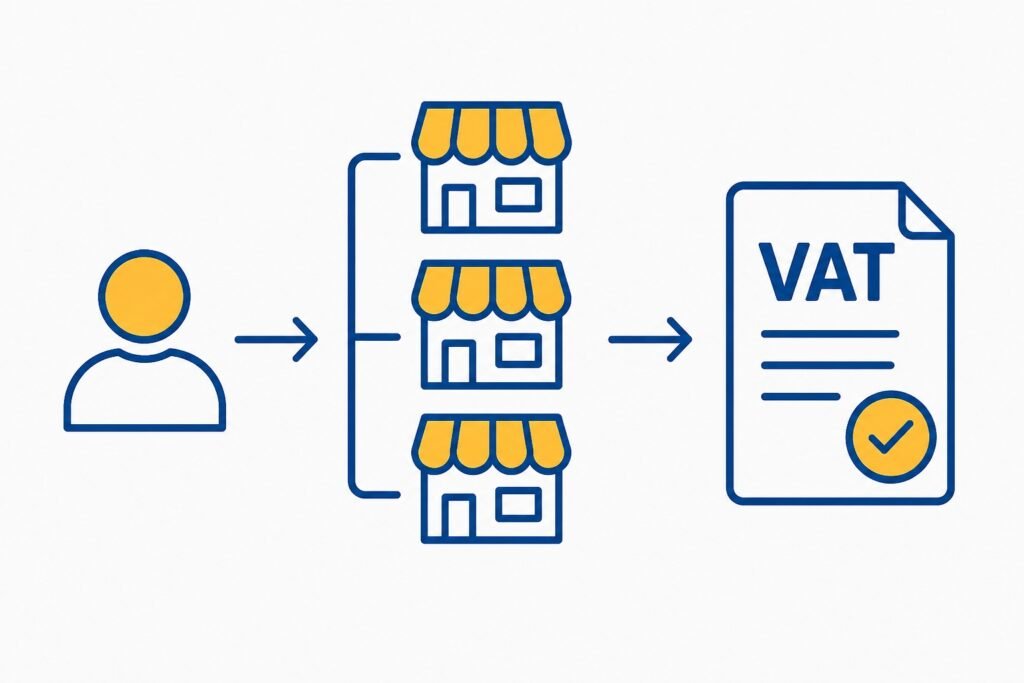
No. A sole trader will usually have just one VAT registration number.
That’s because, for VAT purposes, a sole trader is treated as a single taxable person, regardless of how many businesses they operate.
Even if you run several businesses or trade under different names, your VAT registration is allocated to you (as an individual).
This remains the case regardless of how many businesses or trading names you have.
Why is there only one VAT number?
Unlike a limited company, a sole trader and their business are the same legal entity. There is no legal separation between you and your business. For VAT purposes, HMRC treats you as a single taxable person.
That means all your sole trader businesses are normally covered by a single VAT registration.
Can you have several businesses as a sole trader?
Yes.
Many people operate more than one business at the same time.
For example, you might:
- run a gardening business
- sell products online
- provide bookkeeping services
Each business may have its own customers, branding and records, but they still belong to the same sole trader.
You can read more in our guide to running multiple businesses as a sole trader.
Can you keep each business below the VAT registration threshold?
This is one of the biggest misconceptions about VAT registration.
Some people assume they can operate several small businesses and keep each one below the VAT registration threshold.
In most cases, that isn’t how the rules work.
HMRC normally looks at the combined taxable turnover from all of your sole trader businesses.

80% off Xero Accounting Software for 6 months
Fully compatible with Making Tax Digital (MTD) for sole traders from April 2026.
For example, suppose you have:
- a gardening business with annual taxable sales of £45,000
- an online shop with taxable sales of £35,000
- a bookkeeping business with taxable sales of £25,000
Individually, none of the businesses exceeds the VAT registration threshold.
Together, however, they have taxable turnover of £105,000.
Because they all belong to the same sole trader, you would normally need to register for VAT.
Simply using different business names or keeping separate accounts does not create separate VAT registrations.
Our guide to the VAT registration threshold explains when registration becomes compulsory.
What if you use different trading names?
Using different trading names does not change the situation.
For example, Sarah Jones might trade as:
- Surrey Bookkeeping Services
- SJ Payroll Solutions
Although customers see two different brands, both businesses belong to the same sole trader.
The same VAT registration number would normally be used for both.
You may also find our guide to choosing a sole trader business name useful.
Do you submit one VAT return?
Yes.
If all of your businesses are carried on as a sole trader, you would normally submit a single VAT return covering all of your taxable business activities.
That includes sales and purchases from every business within your VAT registration.
When could you have more than one VAT number?
Usually only where there are separate legal entities.
For example, you might:
- run a sole trader business
- also own a limited company
The limited company is a separate legal entity, so it can have its own VAT registration and VAT number.
The same principle applies to partnerships and LLPs.
Related guides
- VAT registration for small businesses
- VAT registration threshold
- A beginner’s guide to VAT
- Can you run multiple businesses at once?
- Choosing a sole trader business name
Further reading: HMRC’s VAT registration guidance explains who must register and how VAT registration applies to sole traders.