

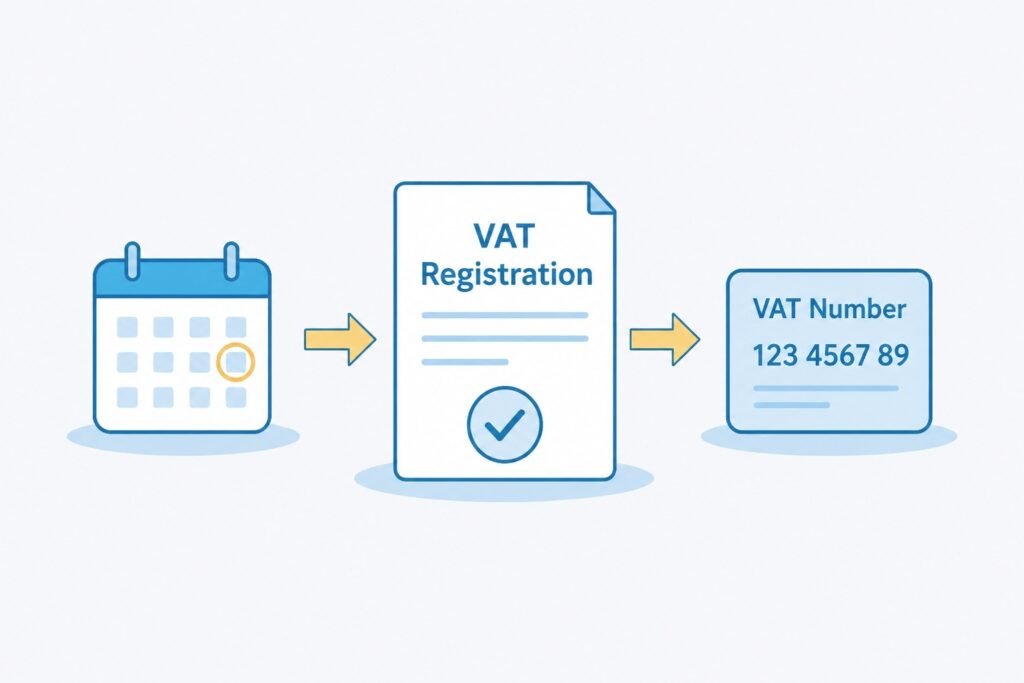
If you’ve applied for VAT registration but are still waiting for your VAT number, you may be unsure whether you should start charging VAT.
In most cases, the answer is no.
You should not issue a VAT invoice or show VAT as a separate charge until HMRC has confirmed your VAT registration number.
However, there’s an important point that catches many new businesses out. If HMRC gives you an earlier effective date of registration, you will usually need to account for VAT on sales made from that date, even if your VAT number arrived later.
Why does this happen?
HMRC doesn’t always process VAT registrations immediately, and while your application is being processed, your business may continue trading as usual.
Once the application is approved, HMRC will issue both a VAT registration number and an effective date of registration.
Those two dates are often different.
For example, your VAT number might arrive on 28 July, but HMRC could make your registration effective from 10 July. In that case, sales made from 10 July onwards would normally be subject to VAT.
Can you add VAT to your invoices?
Not until your VAT registration number has been issued.
A valid VAT invoice must include your VAT registration number, so you should not simply add 20% VAT to an invoice while you are still waiting for it.
HMRC explains what information must appear on a VAT invoice in its guidance on VAT invoices.
What should you do while you’re waiting?
If your effective registration date has already passed, keep a record of every sale you make.
The approach most accountants recommend is to charge your usual VAT-inclusive gross price from the outset, rather than invoicing at your normal (VAT-exclusive) price and hoping to collect the VAT element later.
For example, if a service is normally £100 plus VAT, invoice £120, and add a note such as: “VAT registration applied for. A VAT invoice will be issued once our VAT number is received”.
This way, once your number arrives, you simply reissue the invoice to show the £100 net and £20 VAT separately – your customer pays the same total, but now has a valid VAT invoice.

80% off Xero Accounting Software for 6 months
Fully compatible with Making Tax Digital (MTD) for sole traders from April 2026.
This protects your cash flow because the VAT portion has already been collected, rather than needing to be recovered later from a price you’d already treated as fully yours.
Some businesses instead delay invoicing altogether until the number arrives, or invoice at the net price and issue a separate invoice for the VAT afterwards.
However, if you invoice at your normal price and later ask the customer to pay the VAT separately, there is no guarantee they will agree. You could end up paying the VAT yourself.
If you charge a VAT-inclusive price upfront, you avoid this risk.
We strongly advise you to check your situation with your accountant, particularly if you expect to issue any sizeable invoices while you wait for your registration number to arrive.
If you’ve agreed on a fixed price
This is something to be careful about.
If you’ve agreed to complete a job for £1,200, for example, while waiting for your VAT number to arrive.
HMRC might later confirm that the work falls within your VAT registration period; you may have to treat that £1,200 as being VAT-inclusive.
This means that part of your original £1,200 payment (£200) is now owed to HMRC, reducing your net income from the job.
For this exact reason, many businesses make customers aware that their VAT registration is in progress before agreeing on prices, and build the VAT-inclusive assumption into the fixed price from the start.
Business customers
If your customer is VAT registered, they will normally want a valid VAT invoice before reclaiming any input VAT.
Most businesses understand that HMRC can take time to process VAT registrations. Let the customer know that your application is in progress and that you’ll issue a VAT invoice as soon as you receive your registration number.
Keep accurate and timely records
During the waiting period, keep details of every invoice you issue.
You should record:
- the invoice date
- the amount charged
- the customer
- whether the price was agreed before or after your effective registration date
This will help when you prepare your first VAT return.
Can you reclaim VAT on earlier purchases?
Possibly.
Once registered, you may be able to reclaim VAT on certain goods and services purchased before your registration became effective, provided you meet any conditions set by HMRC.
There are time limits to be aware of: generally, you can reclaim VAT on goods you still hold going back up to 4 years, and on services going back up to 6 months before your effective date of registration.
You’ll need valid VAT invoices in the business’s name and, for goods, evidence that you still own them.
This is one reason it’s worth keeping VAT invoices even before your registration is approved.
Don’t confuse your VAT number with your registration date
These are two different things.
Your effective registration date determines when you become responsible for accounting for VAT.
Your VAT registration number allows you to issue valid VAT invoices.
Further reading
If you’re registering for VAT for the first time, these guides may also help:
- VAT registration for small businesses
- VAT registration threshold
- A beginner’s guide to VAT
- How to cancel your VAT registration
For the latest guidance, see HMRC’s pages on registering for VAT and VAT invoices.