


Managing time effectively is vital if you want to succeed as a business owner – especially when you’re running a small operation where just one or two people are handling everything.
Despite best intentions, we’ve all reached the end of a day without completing any of the tasks we set out to do that morning.
There are plenty of tips and tools out there to help with the age-old problem of time management. Many over-complicate what should be a fairly simple principle. But Covey’s Matrix has stood the test of time, and it’s something that every business owner – including sole traders and freelancers – can benefit from.
It’s the simplicity of Covey’s Matrix, and the way it helps you visualise how and where your time is spent, that has made it a popular tool with managers and consultants for decades.
In this article, we’ll look at the fundamentals of the matrix, and explore a common problem that can waste huge amounts of time if left unchecked – and what you can do about it.
What is Covey’s Matrix?
Covey’s Matrix is a box divided into four areas, or ‘quadrants’, with each one representing how your working time is divided based on urgency and importance.
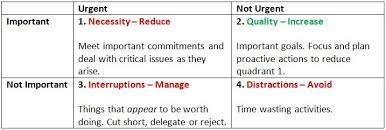
The matrix as a whole represents your total time – that part’s fixed – but how much time you spend in each quadrant can be changed. The aim is to shift as much of your time into quadrant two, while reducing the time spent in the others.
To Covey, this is the core principle of time management – and it’s a simple one.
Let’s take a look at each quadrant in turn, with some practical examples.
Quadrant 1: Important and Urgent (Do it now)
You need some flexibility here, as this quadrant covers crisis situations that can’t be planned for and often demand immediate attention – like technical issues or system failures.
Tasks can also land here due to poor planning. That’s usually a sign you’re not spending enough time in quadrant two, where the real preventative work happens.
Quadrant 2: Important and Not Urgent (Do later)
This is where you should be spending most of your time.
The goal is to work on important tasks before they become urgent, helping you stay in control of your schedule and avoid unnecessary stress.
It’s easier said than done, of course. Business owners who manage this well have often learned to delegate more effectively or block out focused time to stay ahead of their workload.

95% off Xero Accounting Software for 6 months
Fully compatible with Making Tax Digital (MTD) for sole traders from April 2026.
Quadrant 3: Not Important and Urgent (Delegate)
In a business context, this quadrant usually covers things that feel urgent but aren’t important to you directly – often issues passed on by staff or clients.
This is sometimes referred to as ‘staff-imposed time’, and learning to manage it is key.
This is where the idea of monkey management comes in. A “monkey” is someone else’s problem that you agree to take on. You end up carrying it, which not only derails your priorities but also prevents others from solving their own issues.
Good time management often means saying no, or at least not taking on tasks that aren’t your responsibility.
Quadrant 4: Not Important and Not Urgent (Don’t do / Avoid)
This is the distraction zone – meetings that don’t need to happen, pointless admin, or tasks that just fill time rather than move your business forward.
The tricky thing is, you often don’t realise you’re in this quadrant until afterwards. Hindsight helps you spot what’s been a waste of time – so you can avoid it next time, or delegate it if needed.
Putting it into action
Time management is personal, but there are some principles that apply to every business owner – and Covey’s Matrix lays them out clearly.
The more you use it, the more aware you’ll be of where your time is actually going. Once you can see it, you can start shifting time in the right direction.
Try reviewing last week’s schedule. How much time did you spend in each quadrant? Be honest. Then look at the week ahead – what changes could you make to spend more time where it counts?
Originally published on ByteStart and written by Peter Quintana of High Growth Knowledge Company. This article was reviewed and lightly updated in 2025 to reflect current time management practices for small business owners and the self-employed.