
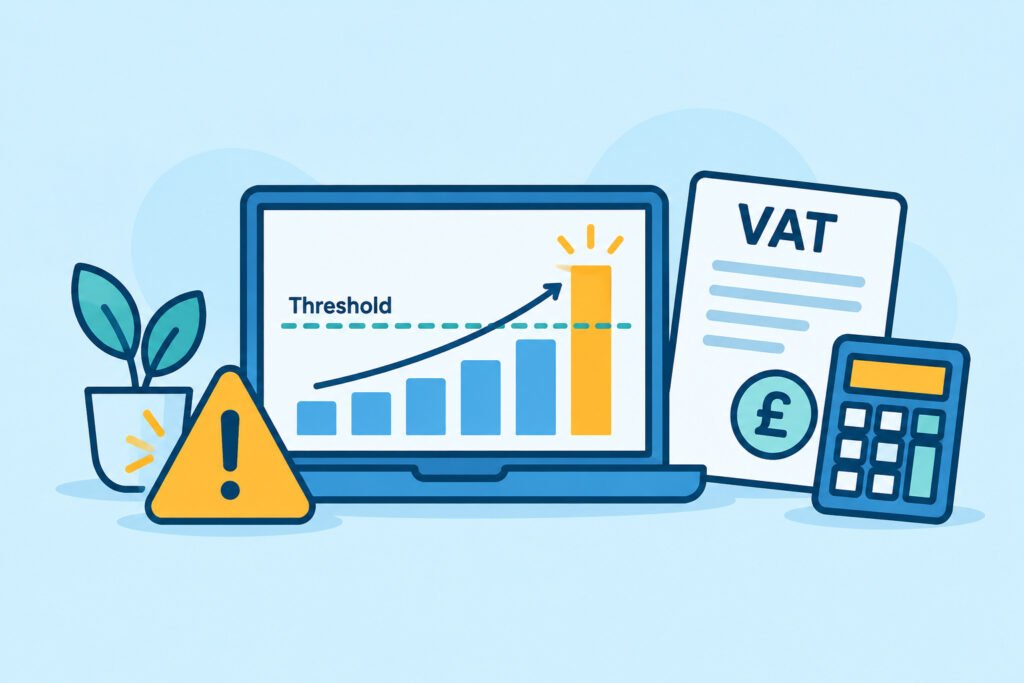
It is quite easy for sole traders to go over the VAT registration threshold without noticing immediately, particularly if sales have risen quickly, or you’ve taken on a large job.
If this happens, the main thing is to work out when your taxable turnover first crossed the threshold. You may need to register retrospectively and pay VAT from the date your registration should have taken effect, even if you did not charge VAT to customers at the time.
How the VAT threshold works
The VAT registration threshold is currently £90,000 of taxable turnover. This is not measured by tax year or calendar year. Instead, you normally look back at your taxable turnover over the previous 12 months at the end of each month.
If that total goes above £90,000, you must normally register within 30 days of the end of the month in which you crossed the threshold. Your effective date of registration is then the first day of the second month after you went over it.
For example, if your rolling 12-month turnover first exceeds £90,000 during June, you would normally need to register by 30 July, with VAT registration taking effect from 1 August.
A separate rule applies if you expect your taxable turnover to exceed £90,000 in the next 30 days alone.
In that situation, you have to register by the end of the 30-day period, and your registration takes effect from the date you first realised the threshold would be exceeded.
See our guide to VAT registration, or HMRC’s VAT registration guidance for the full rules.
What should you do if you realise you went over the threshold?
Go back through your sales records and work out the first month during which your taxable turnover for the previous 12 months went over the £90,000 threshold.
That date determines when you should have registered and how far back any VAT liability may go.
If you should already have registered, submit the registration using the correct date rather than treating the date you discovered the mistake as the starting point.
HMRC can backdate your registration to the date it should originally have taken effect.
This can create an unexpected tax bill because you are liable for VAT on taxable sales made from that effective registration date. HMRC says businesses that register late must pay the VAT due on sales made since the date they should have registered, and a penalty may also apply depending on the circumstances and how late the registration is.
What if you did not charge your customers VAT?
This is where missing the threshold can become expensive. You may owe HMRC VAT even though the invoices you sent at the time did not include VAT.
For example, if you charged a customer £1,000 for a standard-rated service after the date your VAT registration should have taken effect. If you cannot go back and charge the customer anything extra, that £1,000 may effectively have to be treated as VAT-inclusive. At a 20% VAT rate, the VAT element would be £166.67, leaving you with £833.33 rather than the £1,000 you originally thought you had earned.
Whether you can recover extra VAT from the customer depends on the agreement you had with them at the time.
It may also be easier where your customers are VAT-registered businesses, because they may be able to reclaim the VAT once you can provide a valid VAT invoice.
If you have applied for VAT registration but are still waiting for your number, read our guide to charging VAT while waiting for your VAT number.
Can you reclaim VAT on your own costs?
You may also be able to reclaim VAT on qualifying business purchases, subject to the usual VAT rules and being able to provide suitable evidence.
This can reduce the amount you ultimately owe HMRC, although it does not change the date from which you should have been registered.
Read more in our small business VAT guide.
Will HMRC charge me a penalty?
It is possible that you will face a penalty if you failed to inform HMRC that you ought to have registered. It depends on your own circumstances, including how the mistake arose, how much VAT is involved and how quickly you put things right after discovering it.
If you spot the problem yourself, it makes sense to deal with it promptly rather than wait for HMRC to identify the issue.
Read more in HMRC’s detailed guidance on failure to notify penalties.
What if you only went over £90,000 temporarily?
You may be able to apply for an exception from VAT registration if you exceeded the threshold under the normal rolling 12-month test but can show that your taxable turnover will fall below the VAT deregistration threshold over the following 12 months.
This is not automatic. You need to apply to HMRC and show why you expect your taxable turnover to fall back below the relevant level over the following 12 months. The exception is only available under the normal rolling 12-month test, so it does not apply if you expect to exceed £90,000 in the next 30 days alone.
Keep an eye on turnover before you get close
The simplest way to avoid being caught out is to monitor your taxable turnover throughout the year, rather than only when your accounts are prepared. Once you are into the £80,000s, one particularly good month or a large contract can be enough to take you over the VAT threshold. This task is made much easier if you use accounting software.
Also, if your turnover falls again after you register, your VAT registration does not simply terminate. You normally need to apply to HMRC to cancel it once your taxable turnover is expected to stay below the deregistration threshold.
See our guide to cancelling VAT registration for the rules.