

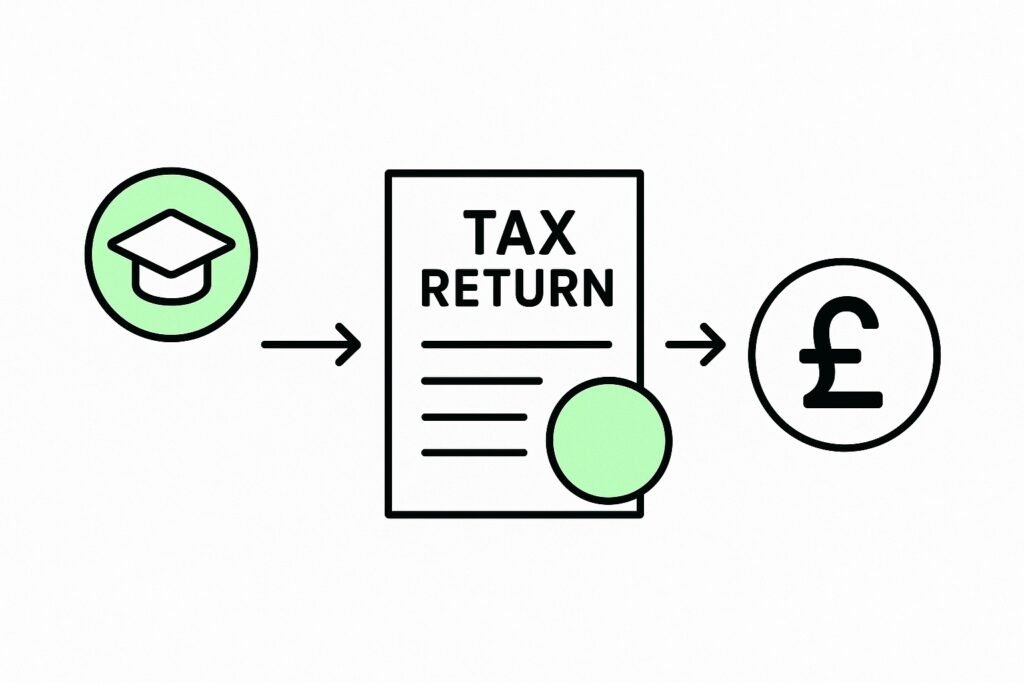
If you’re self-employed, your student loan isn’t deducted automatically as it is from an employee’s payslip – you repay it through your Self Assessment tax return.
At the end of each tax year, once you’ve submitted your return, HMRC checks your total income and works out how much you owe. The repayment is added to your Income Tax and National Insurance bill, due by 31 January after the tax year ends.
It’s reasonably straightforward once you know the system, but the different loan types and thresholds can still be confusing.
This guide explains how student loan repayments work for sole traders and others who work for themselves, with a quick note on how things differ for limited company directors.
How repayments work when you are self-employed
Repayments aren’t taken each month – they’re based on your annual profits. HMRC works out what you owe from your Self Assessment return and adds it to your tax bill.
If your income is below the repayment threshold, you won’t pay anything that year. Earn more, and your repayment increases in line with your profits.
If you’re new to Self Assessment or returning after a break, read our overview here.
The repayment plans and current thresholds
The Student Loans Company assigns each borrower a plan. HMRC uses that plan to apply the correct threshold and rate.
- Plan 1: Most Northern Ireland borrowers and older English or Welsh loans. Threshold £26,065. Repay 9% above the threshold.
- Plan 2: Most English and Welsh borrowers who started from 2012 onwards. Threshold £28,470. Repay 9% above the threshold.
- Plan 4: For Scottish loans. Threshold £32,745. Repay 9% above the threshold.
- Postgraduate Loan: Separate from the above. Threshold £21,000. Repay 6% above the threshold.
Thresholds shown are for the 2025/26 tax year (see the official data). They are reviewed each year.
How does HMRC calculate the repayment?
For a sole trader, HMRC first calculates taxable profits after deducting allowable expenses. It then adds any other income that counts for student loan purposes (see below).
The 9% rate applies to the amount of income you earned above your plan threshold. If you also have a Postgraduate Loan, HMRC applies the 6% test separately and adds the two results to your final statement.
The calculation follows the same rules explained here in HMRC’s repayment guidance.
If your income is below the threshold, there is nothing to pay for that year. You do not need to claim an exemption. However, it’s worth noting that interest continues to accrue until the balance is cleared or written off under the rules of your plan.
What income counts for student loan purposes?
HMRC looks at your total taxable income, not just the trading profits from your business.
The list typically includes:

90% off Xero Accounting Software for 6 months
Fully compatible with Making Tax Digital (MTD) for sole traders from April 2026.
- Trading profits from self-employment (after deducting business expenses).
- Salary from any employment in the year.
- Dividends that you receive personally (e.g. from a limited company).
- Rental income and savings or investment income.
If you make contributions towards a pension or Gift Aid donations, this can reduce your total taxable income for the year.
Typical examples for 2025/26
- Plan 2 example. Profits of £45,000. Threshold £28,470. Amount above threshold £16,530. Repayment 9% of £16,530, which is £1,487.70.
- Plan 4 example. Profits of £40,000. Threshold £32,745. Amount above threshold £7,255. Repayment of 9%, which is £652.95.
- Plan 1 example. Income of £40,000. Threshold £26,065. Amount above threshold £13,935. Repayment of 9%, which is £1,254.
These liabilities are added to your Self Assessment bill.
Payment is due by 31 January following the end of the tax year.
You can check repayment dates and thresholds on GOV.UK.
What if you have both PAYE and self-employed income?
This is a very typical scenario for a lot of self-employed people.
Many people are standard employees who move into self-employment during a tax year or receive self-employed income on the side.
If your employer deducted student loan repayments via payroll, these amounts will appear on your P60. HMRC credits them against the total calculated from your tax return, so you do not pay twice.
If your self-employed income pushes you above the threshold, HMRC will collect the extra 9% through your Self Assessment bill. You can find out more in HMRC’s repayment guide.
Keep your P60 and payslips in a safe place, and check that the payroll deductions you have already made are correctly recorded on your tax return before you submit it to HMRC.
What about postgraduate loans?
Postgraduate Loans are calculated separately at a rate of 6% of income above £21,000.
If you hold both an undergraduate plan and a Postgraduate Loan, HMRC runs both calculations and combines the results on your final statement.
Your total repayment can therefore include a 9% and a 6% element in the same year. You can find full details of the Postgraduate Loan system on GOV.UK.
What happens if you run a limited company?
If you are a company director, the amount you repay is based on your personal income, not your company’s turnover or profits.
This typically includes the salary and dividends you receive during the tax year, plus any other sources of income.
For background on how directors usually pay themselves, see our guides on paying yourself from a limited company and the salary and dividend split.
When repayments stop or change
You stop repaying when the balance is paid in full or your plan writes off the loan.
Write-off dates vary by plan, typically between 25 and 30 years after you first became liable to repay.
You can find full details of write-off rules in GOV.UK’s repayment information.
If your income drops below the threshold in a later year, your repayments will be paused automatically until your earnings rise again. Please note that interest continues to accrue in the background, in accordance with your plan’s rules.
A few practical tips for sole traders
- We recommend putting aside around 9% of income above your threshold throughout the year so the January bill does not come as a surprise. If you also have a Postgraduate Loan, add an extra 6% to the amount above £21,000.
- Check your plan type and the current threshold each time you file a new tax return. Thresholds can change from April.
- If you earned both as an employee and as a sole trader, cross-check your P60 figures before you submit the return.
- If you make voluntary repayments directly to the Student Loans Company, note them clearly in your records so you can reconcile statements later.