

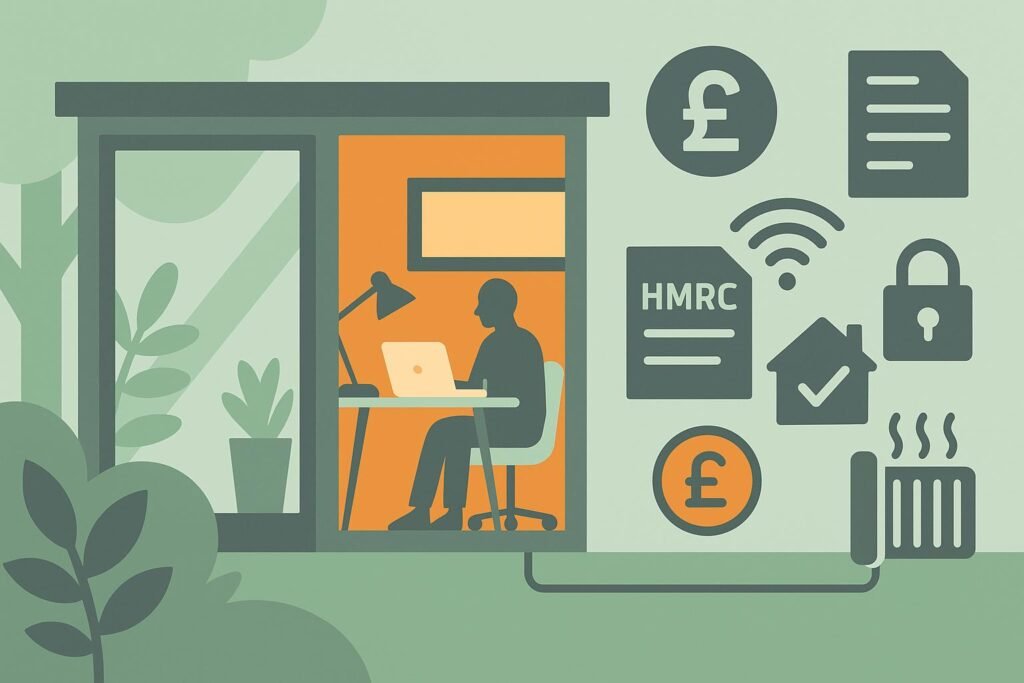
Most new businesses are started from home. But with space at a premium, and with households busier than ever, might buying a garden office offer a practical solution for your startup? And what if you want to reclaim the costs through your small business?
Starting a business from home is a very sensible way to get going. You reduce many financial risks by operating from premises you already own.
It is also easier to make the right decisions early on if you are not waking up each day wondering how you will cover your overheads.
A useful solution for space-starved entrepreneurs
As your new venture grows, you may find that your business has outgrown your spare bedroom. You might need extra space, want to take on staff without them moving through your house, or prefer a more professional environment when clients visit.
If renting or buying business premises seems too costly or too much hassle, there is another option that retains many of the benefits of working from home while solving some of its limitations.
Welcome to garden office buildings. These are purpose-built structures installed in your garden or elsewhere on land you own. Manufacturers claim they are changing the way people work from home.
Typically built from wood and other durable materials, they are assembled in a modular way, much like pre-built shed panels. You can buy single-person models or larger models that accommodate several people.
They are not permanent buildings, but they are solid enough to run a business from and usually last many years. They also have the advantage of requiring a single upfront cost, rather than ongoing rent.
Garden offices: things to consider before taking the plunge
We have looked at several UK suppliers, including Henley Offices and The Garden Escape.
Planning permission
Many garden offices are designed to sit within permitted development rules. Because they do not need foundations, they are often classed as temporary structures like sheds.
However, you may need permission if your garden is very small, you live in a conservation area, or you expect a high number of visitors. Most suppliers can advise on this.
Installation
Most suppliers assemble their buildings on site. Depending on the size, installation can take as little as a day, as panels are pre-made in the factory. Flat sections can often be carried through your house if you do not have rear access. Although foundations are not usually required, laying slabs first is recommended.
Cost
Although garden offices offer the convenience of other outbuildings, they are priced more like proper structures. Expect to spend a few thousand pounds for a small office, rising beyond £20,000 for larger models suitable for employees. Some manufacturers also offer bespoke designs at a premium.
Electricity
As these buildings are designed for work, they come with sockets and internal wiring installed. You will need a qualified electrician to connect the building to your home, typically via a buried cable, so there is no visible disruption to the garden.
Heating
These are proper insulated buildings, often with double-glazing. You may still need an electric or portable heater in winter.

80% off Xero Accounting Software for 6 months
Fully compatible with Making Tax Digital (MTD) for sole traders from April 2026.
Because the structure is wooden, take normal fire-safety precautions, including extinguishers. If employees also work in the office, ensure it complies with relevant fire regulations.
Connecting to the outside world
Thanks to modern wireless technology, you probably will not need to lay telephone lines to the garden. A wireless router and cordless phone often work well, depending on the distance from the house.
Booster units are available for larger gardens. Always test the signal before choosing your location. If Wi-Fi cannot reach, mobile data or a 4G/5G dongle may be a simple alternative.
Security and insurance
Garden offices are generally sturdy, with secure doors and locks. Many insurers will cover them under your home policy. Some manufacturers also offer higher-security models.
As an extra precaution, you may prefer to remove laptops and valuables at the end of each day.
Downsides
Although you have moved your workspace outside, you are still working from home and will need the discipline that goes with it. It is easy to “pop out for a few minutes” and still be there hours later. Establish clear boundaries, keep regular hours and maintain separation between home and work.
What about the tax treatment of garden offices?
As always, tax adds complexity, and the position varies depending on whether your business is a sole tradership or a limited company.
You may be able to reclaim the VAT element of construction and fitting costs, although this is only possible if you use the standard VAT scheme, not the Flat Rate scheme.
Sole traders must also make an adjustment if there is any personal use of the space.
There may be a theoretical Capital Gains Tax issue when selling your home, but this only arises if the garden office is used exclusively for business. Mixed use normally preserves full main residence relief.
The cost of constructing the building cannot be offset against Corporation Tax if you trade as a limited company. However, most businesses can claim some elements through the capital allowances system.
In theory, your local council could apply business rates to the structure. However, given its size, it would almost certainly fall within small business rates relief.
If the office has mixed use (for example, it doubles as a leisure space), HMRC may treat the personal use element as a benefit-in-kind.
- David Hughes from Rodliffe Accounting provides a detailed breakdown for limited company owners here.
- Here is a useful summary for sole traders and partnerships seeking to reclaim the cost of a garden office.
- A further guide to running a business from a garden office is available from Garden Affairs.
As you can see, if you want to claim the cost of constructing a garden office, we strongly recommend speaking with your accountant first.