
Opening a business bank account is one of the first practical steps you take after deciding to become self-employed.
The process is usually straightforward, but the time it takes can vary considerably depending on the type of bank you choose and how prepared you are when you apply.
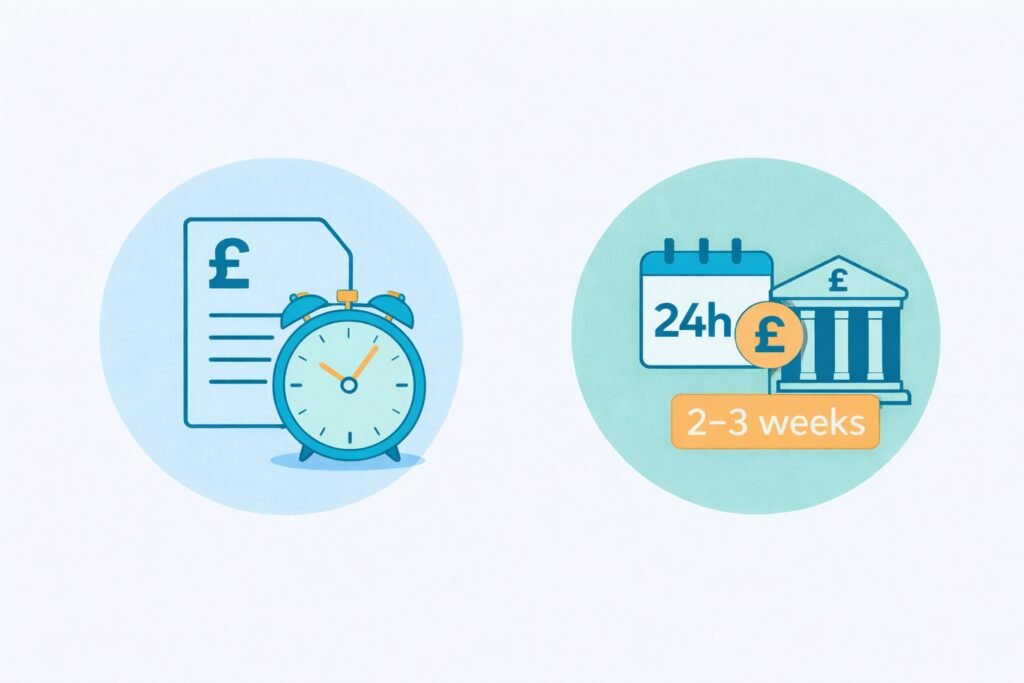
In some cases, you can have an active account number and sort code within hours or by the next working day.
In others, it can take several weeks.
- Digital or app-based providers: often take minutes to 24 hours.
- High street banks: typically take 5 to 15 working days.
- More complex applications: can take several weeks.
The main differences usually come down to identity checks, how the bank verifies your business, and whether the application needs to be reviewed manually.
Why do processing times vary so much?
Banks have to conduct anti-money laundering (AML) and know-your-customer (KYC) checks. This means they need to verify you (a sole trader) as an individual, rather than your business, because it’s not a separate legal entity like a limited company.
Many checks are now automated, although some banks still review applications manually.
Some of the main factors include:
- Whether you apply online or in a branch.
- The type of bank you choose.
- How smoothly ID checks can be processed.
- The nature of your business activity.
- Any previous credit or fraud markers linked to your name.
Digital business accounts are usually the fastest
Most sole traders choose an app-based business account, such as Tide, ANNA or Zempler.
These providers are designed specifically for sole traders and small businesses. They typically offer the fastest onboarding.
In straightforward cases, you may receive your account number and sort code within minutes of applying.
Typical timeline for digital banks
- Completing the application form: around 5 to 10 minutes.
- Completing identity checks: instant to a few hours.
- Your account goes live: the same day or within 24 hours.
To complete the ID verification process, you will usually need a current photo ID (passport or driver’s licence). You will then be asked to provide a selfie or a short video to verify your identity. You will also need to describe the nature of your business.
You do not normally need to provide any invoices or proof of income.
That’s because the bank is assessing you as an individual rather than judging whether your business is already established.
Some leading digital banks include Tide, ANNA Money, and Zempler.
You can also compare features and integrations in our guide to choosing a sole trader bank account.
High-street banks usually take longer
Traditional banks tend to take longer, particularly when they require in-branch identity checks or manual compliance reviews.
Typical timescale
- Completing the application form: 20 to 40 minutes.
- Verification and manual reviews: one to three weeks.
- Your account goes live: once all checks are complete.
You’re more likely to experience delays if you have recently changed address, or if your ID doesn’t match the electoral roll or other official records.
Can you open an account before you start trading?
Yes. Most banks allow sole traders to open a business bank account before they have started trading, provided they genuinely intend to do so.
You may be asked when you expect to start trading or receive your first payment, but you are not normally expected to provide invoices at this stage.
Read more in our guide to opening a business bank account before you start trading.
You may also find our guide to registering as self-employed helpful if you’re still deciding whether to start a business.
What slows applications down most often?
If your application is delayed, it is often for one of the following reasons.
Identity or address mismatches
For example, if you recently moved house, are using an address that does not match your ID, or you’re not listed on the electoral roll.
Manual compliance checks
Certain industries, international payments or overseas clients may require additional review by a bank’s compliance team.
Fraud or credit markers
Opening a business bank account is not an application for credit, but banks still screen for CIFAS markers and previous account closures.
This does not always mean your application will be rejected, but it can delay processing.
We explain this in more detail in our guide to opening a business bank account with bad credit.
How to speed the process up
- Use a digital provider if speed is your priority.
- Make sure your address matches the one on your ID and official records.
- Have your photo ID ready before you start the application.
- Use a clear, simple description of your business activity.
- Avoid applying to multiple banks at the same time.
What happens once your account is approved?
Once approved, most providers issue your account details immediately. Debit cards usually arrive within a few days, while online banking is normally available straight away.
Once your account details are live, you can start receiving customer payments immediately.
At this point, you may also want to review how your new account integrates with your bookkeeping in our guide to bookkeeping for sole traders.
If you’re still unsure whether you legally need a separate account, see our guide on whether you need a separate bank account as a sole trader.